
Patches based on protein from waste products could speed up wound healing
Developing effective wound healing patches remains a challenge. In parallel, manufacturing drug delivery systems in a non-toxic and environmentally safe way is becoming a priority in biotechnology.

Today, gauze is the most common wound dressing, as it is cheap and widely available. But one of the disadvantages is that it tends to dry out the wounds in a way that doesn’t help or speed up the healing process. To find a better solution, researchers from the Department of Pharmacy are developing biocompatible patches made of protein fiber structures, which can be tailored to deliver various drugs.
This new type of wound dressing is also part of the important work towards more sustainable solutions in the production of drugs which is often dependent on processes that are toxic for the environment.
“We want to produce the new materials following green principles”, says Professor Vito Foderà, “and the new materials should also be effective for wound healing and drug delivery”.
Early in the process, the team began investigating food proteins, also originating from waste products from the industry, such as soybeans, potatoes and milk for the fibers. They also redesigned the drying process for the fibers and have ended up with a solution that only requires water as a solvent.
“Our main philosophy is to use proteins that are largely available, such as those recovered from food waste”, Vito Foderà says.
Creating patch fibers with electrospinning
Using proteins from food waste is in itself a sustainable process, but another aspect has been reinventing the production of the fibers for the patches using a more sustainable method. Electrospinning is a drying process for forming nanofibers, a process that produces materials that are well suited for wound healing because of their porous structure and their capability to support cell growth. Their fibers are also very well suited for containing a wide variety of drugs, such as antibiotics or anti-fungal drugs.
This creates a multifunctional product for wound healing, in which support for tissue regeneration and delivery of drugs are integrated in a single device.
But electrospinning is usually a process that is quite hard on the environment because it involves organic solvents. The team has redesigned the fiber manufacturing process, a project that has resulted in a new way of electrospinning that only involves water as a solvent.
While electrospinning is mainly used for polymers, the team has developed new types of fibers from food waste, both from proteins plants and animal origins. These protein fibers turned out to be very biocompatible.
A milk protein with promising effects for wound healing
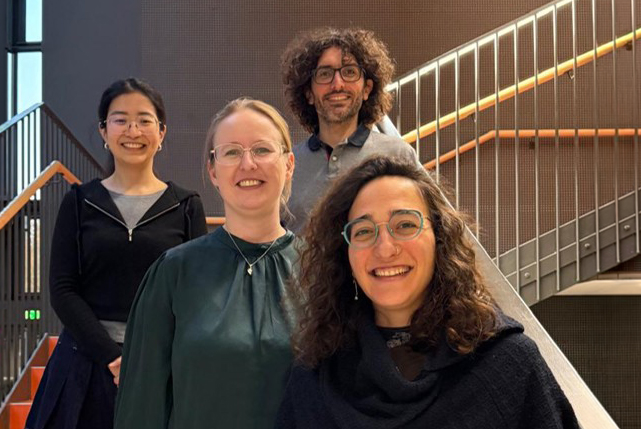
Vito Foderà and the team composed by Mai Bay Stie, Kleopatra Kalouta, Xuedan Sun have investigated, among others, a milk protein that has shown very promising properties when used as fibers in the patches. The milk protein α-lactalbumin (ALA) is rich in amino acid and acts as a precursor of serotonin, a signaling molecule that not only plays a key role in the central nervous system, but also in wound healing.
The researchers electrospun this milk protein and made patches that they tested in the laboratories. What they could see here was that the fiber material with this milk protein can both help the skin in the tissue healing process and help prevent the formation of scars.
Contact
Professor Vito Foderà
Mail: vito.fodera@sund.ku.dk
Article by:
Communications Adviser Lisbeth Lassen